Since September 2010, this blog has recorded the journey of this music junkie as I attempt to listen to all the music in my CD collection. CDs revisited in their entirety from start to finish - no skipping tracks, no shuffle. Compact Discs only - no vinyl, no tapes, no files.

Showing posts with label 1964. Show all posts

Thursday, May 14, 2026

Ike Quebec - It Might As Well Be Spring (1964)


Note: the CD I listened to was the 2006 Rudy Van Gelder Edition.

This album was recorded on December 19, 1961, but the LP wasn't released until 1964. In the meantime, Quebec tragically died of lung cancer in January 1963 at age 45. Delayed album releases happened fairly often with Blue Note in the '60s as musicians recorded many brilliant sessions while Alfred Lion calmly stacked tape boxes like a jazz leprechaun sitting on a pot of gold. Some records appeared years or even decades later. In any case, this is quality stuff and well worth a listen, regardless of year.

I always use the word "meaty" to describe Quebec's tone, but I'm getting out my thesaurus and opting for "luxuriant" in today's post. The program is relaxed, romantic, and perfect for late night listening. Pairs quite well with Quebec albums Blue & Sentimental and/or Heavy Soul. Organist Freddie Roach is the perfect band member, knowing exactly when to shine and when to support. I gotta tell ya, I was completely unfamiliar with Quebec until I fell down the RVG Editions rabbit hole around 2020. And boy-oh-boy am I happy to have finally heard his stuff. I simply love his tone. Had he lived, he would have no doubt given other soul-jazz saxophone players such as Stanley Turrentine and Lou Donaldson a run for their money throughout the decade.

Quebec - tenor saxophone
Freddie Roach - organ
Milt Hinton - bass
Al Harewood - drums

Original liner notes by Nat Hentoff.

Reviews/ratings:
  • CashBox: "The jazzophiles will want this one."
  • DownBeat (★★★★): "the playing is as relaxed and spontaneous, yet cohesive, as if these were four steady companions."
  • The Penguin Guide to Jazz (5th ed., 2000): ★★★½
  • The Rolling Stone Jazz & Blues Album Guide (1999): ★★★
  • The Virgin Encyclopedia of Jazz (1999): ★★★

Peak on the US Billboard Top 200 chart: Did not chart

Tracks: The album is brief (35:37), but like Quebec's playing, it is all very economical - no wasted space here. Of the four standards and two Quebec originals, the highlight is the beautiful title track, a wonderful Rodgers & Hammerstein ballad originally from the 1945 film, State Fair.

Personal Memory Associated with this CD: None

Previously revisited for the blog:
Easy Living (1987)
Blue & Sentimental (1963)
Heavy Soul (1962)


Sunday, April 14, 2024

Herbie Hancock - Empyrean Isles (1964)


Note: the CD I listened to was the 1999 Rudy Van Gelder Edition with an 2 bonus tracks.

This was Hancock's fourth album release as a leader; a weak attempt at a concept album about the Empyrean Isles, described in the original, atypical liner notes written by Nora Kelly as "elusive and said to vanish at the approach of ordinary mortals" and "that incense-bearing trees blossom there," etc. You get the point. Needless to say, it fails in its task of being a concept album, but there are a couple of destinations here I don't mind visiting, especially Cantaloupe Island.

In 2017, Pitchfork ranked this album at #177 on their list of The 200 Best Albums of the 1960s with the following blurb:
Pianist Herbie Hancock was already an elite jazz session player when he led this set for Blue Note...But Hancock was also hard at work on his compositional craft. His four original pieces on Empyrean Isles prompt motifs based on brisk chord changes as well as scale-based improvisation. Nearly two decades before his embrace of turntablism on “Rockit,” Hancock was already signaling his intention to swing between radically different formal designs. –Seth Colter Walls
So they obviously like the album more than I, as does the uDiscover Music website, where this albums was ranked at #34 on its list of The 50 Greatest Blue Note Albums.

Hancock - piano
Freddie Hubbard - cornet
Ron Carter - bass
Tony Williams - drums

After recording this album, Hancock, Carter, and Williams (plus Wayne Shorter) would soon join Miles Davis to become what is commonly known as his "Second Great Quartet."

Reviews/ratings:
  • Stereo Review: "Lacks cohesion"
  • CashBox: "Jazzophiles should dig this session."
  • Downbeat (★★★★): "the tunes come off well"
  • The Penguin Guide to Jazz (5th ed., 2000): ★★★★
  • The Rolling Stone Jazz & Blues Album Guide (1999): ★★★★
  • The Virgin Encyclopedia of Jazz (1999): ★★★★


Peak on the US Billboard Top 200 chart: Did not chart

Tracks: As I mentioned earlier, Cantaloupe Island is the star here and yes, I was familiar with the tune before it was famously sampled by Us3 in 1992. My other top pick is Oliloqui Valley, which swings harder than it should and features a killer solos from Hubbard and then Carter. That doesn't mean the other two tracks (One Finger Snap and The Egg) aren't good, simply that I much prefer the first two I mentioned. Both One Finger Snap and Cantaloupe Island were chosen for the 1988 CD release, The Best of Herbie Hancock: The Blue Note Years.

Bonus tracks: Alternate takes of One Finger Snap and Oliloqui Valley. All tracks, including the bonus tracks, were recorded at the Van Gelder Studio on Wednesday, June 17, 1964.

Personal Memory Associated with this CD: None

Previously revisited for the blog:
The Best of Herbie Hancock: The Blue Note Years (1988)
Round Midnight - Original Motion Picture Soundtrack (1986)
Lite Me Up (1982)
Sunlight/Feets Don't Fail Me Now (1978/1979)
Head Hunters (1973)
Speak Like A Child (1968)


Wednesday, April 12, 2023

Donald Byrd - A New Perspective (1964)


Note: the CD I listened to was the 1999 Rudy Van Gelder Edition.

Truth in advertising! The title alone indicates this thing is different. After checking out the liner notes and track list (Elijah, Beast Of Burden, Cristo Redentor, The Black Disciple, Chant), the vibe here is obvious:
Donald's most unique venture so far is this evocative fusion of voices with jazz instrumentalists in a setting which is itself a fresh intertwining of traditional religious feelings with modern, jazz-infused idioms.
So we're getting a "spiritual-like" album from a fellow PK (Byrd's dad was a Methodist minister, my own was a Presbyterian minister. Close enough.) The first thing a fresh listener notices is the wordless timbre of a gospel choir. Not at all expected; as I mentioned, this thing is different. Then a stellar cast of instrumentalists enter the fray and we start swinging, but the vocals remain a part of the instrumentation throughout.

I can only imagine what a trip listening to this album must have been upon release because it's still pretty trippy. I always appreciate artists that push boundaries, even if I don't like the results of that push. But that's not the case here. This disc isn't something I play often, but I enjoy it for a nice change of pace every now and then.

Byrd - trumpet
Hank Mobley - tenor saxophone
Donald Best - vibes
Kenny Burrell - guitar
Herbie Hancock - piano
Butch Warren - bass
Lex Humphries - drums

As one would expect, there are great performances from Mobley, Burrell, and Hancock, but I'm pleasantly surprised by the solo contributions from Best, an artist I admittedly don't know much about.

Reviews/ratings:
  • CashBox: "off-beat, interesting set"
  • Billboard: "a sort of jazz gospel montage of images"
  • DownBeat (★★★★½): "one of the most impressive and important efforts of 1964"
  • The Rolling Stone Jazz & Blues Album Guide (1999): ★★★
  • The Virgin Encyclopedia of Jazz (1999): ★★★★
  • The Penguin Guide to Jazz (5th ed., 2000): ★★

In 2017, it was ranked at #194 on Pitchfork's list of the 200 Best Albums of the 1960s.

Update: In 2024, uDiscover Music ranked this album at #31 on its list of The 50 Greatest Blue Note Albums.


Peak on the US Billboard Top 200 chart: #110

Tracks: The Pitchfork list mentioned above describes the album as "a sort of symphony in five movements that incorporated blues, doo-wop, and even opera into its more conspicuous hard bop and liturgical influences." So the thing is meant to be heard top-to-bottom and (after I got over my initial puzzlement with the vocals) I dig the whole thing. Nevertheless, my top tracks include the joyous opener, Elijah, and the hymn-like Cristo Redentor. The latter inspired by Duke Pearson's 1961 arrival in Rio de Janeiro and seeing the Christ the Redeemer statue atop Corcovado.

Personal Memory Associated with this CD: None

Previously revisited for the blog:
Love Byrd (1981)

Saturday, May 9, 2020

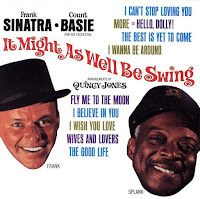
Frank Sinatra - It Might As Well Be Swing (1964)


Note: the CD I listened to was the 1998 reissue.

Originally released about two years prior you my birth, this CD represents the collaboration of a 'perfect storm' of musicians: Sinatra, Count Basie, and Quincy Jones. This brief (27'26") album has everything you could ask for from a Sinatra disc, including leading off with my all-time favorite Sinatra tune: Fly Me To The Moon (In Other Words). It's all a master class in swinging, arranging, phrasing, performing, and, as mentioned below, musical economy: saying more by playing less. Firmly in the pocket. Hold your hat, turn up the volume and dig.

Billboard, August 8, 1964, p. 52

This reissue didn't include the original album's liner notes, an interview with Quincy Jones on the back cover, so I've included them below.

Peak on the US Billboard Top 200 chart: #13

Tracks: Lemme try to rank 'em
  1. Fly Me To The Moon (In Other Words)
  2. I Believe In You
  3. The Best Is Yet To Come
  4. The Good Life
  5. More (Theme from Mondo Cane)
  6. I Wish You Love
  7. Wives And Lovers
  8. I Wanna Be Around
  9. Hello, Dolly!
  10. I Can't Stop Loving You


Previously revisited for the blog:
Sinatra Sings Cole Porter (2003)
The Capitol Years (1990)
Sinatra at the Sands (1966)

For more information on the brief life of the CD longbox,
go visit The Legend of the Longbox.

 
Liner notes:

A Conversation With Mr. Jones

Prior to the recording of this album, arranger and conductor Quincy Jones set up a temporary private studio within the Sinatra offices at Warner Bros. Studios, Burbank, California. At the studio Jones wrote his arrangements: at the same time, Sinatra acted in and, for the first time, directed his new film, "None But the Brave." To prepare for the recording sessions, Jones (whom Sinatra nicknamed "Q") often worked late into the night framing his arrangements, occasionally sleeping at the Sinatra offices.

In the following conversation, Jones discussed the atmosphere at the sessions, the preparations for them, and the musical results. He began by talking about the audiences at the Basie-Sinatra sessions.

It's very helpful to have an audience to play off, particularly when they're responsive and attentive, as the audiences at these sessions were. The atmosphere was very informal, but it was relaxed rather than chaotic. I know Basic's band plays better with an audience, and I think Frank does too. But a remarkable thing about Frank is that he is able to tune them out. When he starts singing, he forgets they're there. He has a fantastic power of concentration. And of course, you really do have to concentrate at a record session because after you get out of there, the music you've made is on record forever.

A lot of work goes into a rehearsal because you're so cognizant that a record is a permanent thing. A lot of sweat is involved. A lot of soul, too, but a lot of work. Each session-and there are usually three for most albums-is only three hours long. I don't think many people realize how serious those hours are. Not that we don't also enjoy ourselves when things are working right-as they did on these dates.

How did the idea of getting Count Basie, Frank Sinatra and you together begin?

It was like a chain letter. I was thrilled because I'd always wanted to work with Frank and I know Basic had wanted to do another album with him after their "Basie-Sinatra" set on Reprise. What happened was that Reprise called and said Sinatra would be back in California from Hawaii, where he'd been shooting on location for "None But the Brave," on May 27th. I said that wouldn't give us much time if we were to record on June 8th or 9th and that I'd like to get with Frank as soon as possible to talk over the songs with him. The next thing I knew I was in Hawaii, and that was beautiful. Frank had said, "Come on over here," and so I picked up Bill Miller, his accompanist, in California and we were off.

How did you two work in Hawaii?

I don't know how Frank finds the time, but within one hour after I arrived in Hawaii (I was-there some six or seven days altogether), we were straight. It was a Sunday, and we met in the home in which Frank was staying. Bill Miller and I came into the room. After being fueled by some "gasoline" (the Jack Daniels kind), we were at the piano. Within an hour, we had all the routines worked out, the modulations, the tempos and the styles for each tune. There were no problems at all. Nothing but love from the beginning. Frank is so alert musically and so resilient that he's marvelous to work with. He was open to all suggestions, and he had some of his own too.

How did things go at the sessions themselves?

To begin with, the way Frank records makes it much easier to establish rapport. Instead of getting off in a kind of isolation booth, as many singers do in a studio, Frank stands in a small half-shell near the rhythm section. There everybody can see him, and he can feel directly what's going on around him. Again, at the dates, Frank was exceptionally aware of the best methods to use, the most comfortable way to do the songs. I remember that in "I Believe in You," for example, there was a little rhythm figure Frank wanted to insert in the bridge. And Basic's drummer, Sonny Payne, remarked at the time what a pleasure it was to work with so musical a singer and to work, moreover, with a man who, in a sense, was able to swing him.

What were some of the ways in which you adapted some of the songs? For example, one of the tunes was "I Can't Stop Loving You," which you arranged for Basie on his Reprise album, 'This Time By Basie." You won a Grammy from the National Academy of Recording Arts and Sciences for that How'd you change it for this album?

We put an intriguing little bass figure underneath it, and we got the strings playing almost saxophone figures on it. They interpreted those patterns very well. I tried to notate it so that if would feel very loose.

Most of the songs come from fairly well known original versions.

Yes, we did take songs which had been identified with very specialized kinds of backgrounds, like Jack Jones' "Wives and Lovers." But we had to transmute them because when you're working with a combination as unique as that of Basie and Sinatra, you have to discard all superfluities and get to the bones of a song before you start building it again. I think we accomplished that. In the case of "Wives and Lovers," for instance, we changed the 3/4 waltz tempo in which it was originally written into 4/4 time. And we also added a kind of mesmeric shuffle beat. "Fly Me To The Moon" had also originally been written as a waltz and later become famous as a bossa nova. For this date, we translated it into a swinging 4/4 time.

How did you select the tunes that would best fit the string-augmented band which was present for two of the three sessions?

It was a difficult challenge. I tried to select those tunes which had the kind of harmonic elements which would be particularly heightened by the colors we can get with strings. "Good Life," for example, and "More." In the latter, the strings seemed especially apt to enhance the groove we were getting.

What is your approach in writing for the Basie band?

I've been with this Basie family for a while now, and I think I understand what they really groove with. Once I can bring an arrangement up to that point-where it's comfortable and right for them-they just take it from there. They add a distinctive personality to the score, a personality of a quality you can never get out of a studio band. For one thing, there is no way any studio band can achieve the cohesiveness of a group that's been together a long time. Take the Basie sax section. It's the best reed section I've heard anywhere in the world -live or on records. One of the reasons for their superiority is that each man in it is an excellent musician, and the other reason is that they've been together for ten years. They are just like a family, and cannot be equalled by anybody.

Another basic factor in the Basie band's personality is that rhythm section. Its beat is so fundamental that, in a paradoxical sense, it's timeless. It seems to go back to the very foundation of what rhythm is. There's Basie himself and Freddie Green and Sonny Payne, whom the musicians call "Magoo." That's another index of the family byplay in the band. Everybody has a nickname. Basie is "Splank," Buddy Catlett is "Bumblebee," and Freddie Green is "Pepper." 

Basie, of course, is renowned for playing as few notes as possible, and that seems to be particularly in evidence in this set.

The word "economy" is an understatement when referring to Basie. During one of the tunes, Frank said, "Give me the pitch, Basie" And Basie hit one staccato note-"splank!"-and it was all there. It's not only economy; it's authority. When Basie plays, there's no waste motion just as there are no wasted notes. He knows exactly what's needed-and how to do it.

You also brought in a few added musicians.

One was Harry Edison, also known as "Sportin' Life" and "Sweets" He's been featured on Frank's dates with Nelson Riddle for years. Edison has a particular quality. In fact, only Joe Newman can also do the kind of thing "Sweets" does. They play their trumpet like a saxophone. Where another trumpeter would play with too much animation or with too wide a range, "Sweets" can say a great deal with just a few notes because he can bend and shake those notes and make them contain so much substance.

You added other brass as well - Al Porcino on trumpet and Ken Shroyer on bass trombone.

We did that because there are times when a singer who is building a groove and building a picture on a song might have to stop and wait until the blood comes back into the trumpet player's lips. By having men in reserve, we don't have to disturb a singer's groove. And we also added percussion-Emil Richards, and, of course, the string section. I should note that the strings contained the loveliest cellist I have ever seen in a string section.

Finally, what distinguishes writing for Sinatra?

To begin with, he is so personal a singer. Nobody can imitate him. Sammy Davis, Jr. is one of his closest friends and yet Frank is the one imitation Sammy really can't do. He can do the mannerisms, but he cannot imitate that sound. Secondly, Frank is unusually sensitive. He is so flexible musically that he fits easily into every situation. And when he has an idea he wants to incorporate, he is able to immediately absorb the whole musical context surrounding that idea. He utilizes every asset he finds, and he's an expert at eliminating stumbling blocks. Both he and Basic have this remarkable ability to eliminate the negative. In "I Wish You Love," for instance, we had a pickup which tipped off the tempo. Frank just omitted it. starting off with the voice. A very natural thing to do and one that worked out perfectly. And there is also his rhythmic sense and inventiveness. He can stretch out a little further even in a set rhythmic figure. And he's not constricted by the melody as it was written. He bends it so that invariably it fits flawlessly into what's going on in the background. So far as I can put the essence of Frank into words, I'd say that he just makes everything work. He makes everything fit, and that's exactly what happened on these sessions.


Thursday, April 2, 2015

The Beatles - A Hard Day's Night (1964)


Note: the CD I listened to was the 2009 stereo remaster.

If I never see the movie again, I'm okay with that, but this sorta-soundtrack album is classic early Beatles, full of Lennon-McCartney short, poppy originals. And when I say short, I mean 13 tracks in 31 minutes. In the end, the brevity doesn't matter when the songwriting is this catchy. The opening chord is legendary and immediately identifiable, then it just gets better from there. The lads were in their early 20s when this was produced which is mind-blowing to me. I work with young adults in their early 20s every day so I'm fully aware of their normal priorities. In any case, this group was not only focused, but talented and influential: the unique chord progressions were beginning to appear and Harrison's 12 string work on this album set the stage for the folk-rock sound of the decade, to give but two examples. The first great Beatles album to be sure, but there were better things to come.

Update: In 2017, it was ranked at #164 on Pitchfork's list of the 200 Best Albums of the 1960s. And in its 2020 list of The 500 Greatest Albums of All Time, Rolling Stone ranked A Hard Day's Night at #263.


Album chart peaks:
  • US Billboard 200: #1 (14 consecutive weeks, July 25 - Oct 24, 1964)
  • Billboard Pop CD: #1

Tracks:  It is so hard to pick out favorites because I find myself singing along to every single song on the disc (warning: if you're ever in the car with me, I usually sing the harmony lines as if they were the melody and don't give a care). It's obvious to me that I'm too familiar with these songs to play favorites but I will go as far to say that I prefer side one to side two, but just so.

This "Enhanced CD" comes with a lackluster 4 minute "mini-documentary" on the making of the film. Haven't seen it? You're not missing much.

For more information on the brief life of the CD longbox,
go visit The Legend of the Longbox.

Personal Memory Associated with this CD:  Can't pick one out today. When an album was released before your birth and you never recall a time when you didn't know all the songs, it's too tall an order to fill.

Previously revisited for the blog:
Love (2006)
Let It Be... Naked (2003)
Anthology 2 (1996)
Anthology 1 (1995)
1967-1970 (1973)
1962-1966 (1973)
Abbey Road (1969)
The Beatles (1968)
Sgt. Pepper's Lonely Hearts Club Band (1967)
Revolver (1966)
Rubber Soul (1965)
Help! (1965)
Please Please Me (1963)

Friday, September 23, 2011

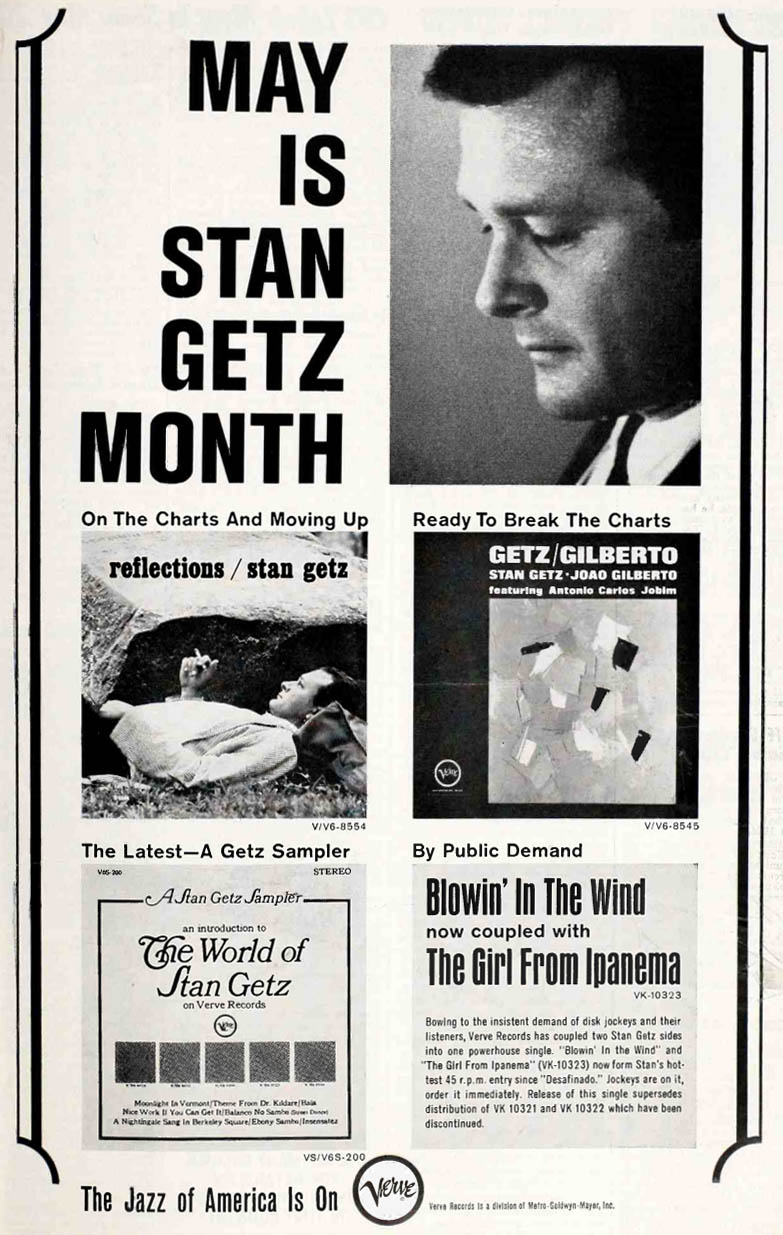
Stan Getz, João Gilberto, Antonio Carlos Jobim - Getz/Gilberto (1964)


Note: this CD is the 1997 reissue containing 2 bonus tracks.

One of my favorites. This classic album is so sublime that I don't have the words to fully describe it, so I'm going to be lazy and cut-and-paste from the allmusic.com review. (I'd also prefer to enjoy the CD without thinking and writing). Here's some of what Steve Huey had to say about this album and I'm in complete agreement with everything he writes:
One of the biggest-selling jazz albums of all time, not to mention bossa nova's finest moment, Getz/Gilberto trumped Jazz Samba by bringing two of bossa nova's greatest innovators -- guitarist/singer João Gilberto and composer/pianist Antonio Carlos Jobim -- to New York to record with Stan Getz. The results were magic. Ever since [Getz's album] Jazz Samba, the jazz marketplace had been flooded with bossa nova albums, and the overexposure was beginning to make the music seem like a fad. Getz/Gilberto made bossa nova a permanent part of the jazz landscape not just with its unassailable beauty, but with one of the biggest smash hit singles in jazz history -- "The Girl From Ipanema," a Jobim classic sung by João's wife, Astrud Gilberto, who had never performed outside of her own home prior to the recording session. Beyond that, most of the Jobim songs recorded here also became standards of the genre -- "Corcovado" (which featured another vocal by Astrud), "So Danço Samba," "O Grande Amor," a new version of "Desafinado." With such uniformly brilliant material, it's no wonder the album was such a success but, even apart from that, the musicians all play with an effortless grace that's arguably the fullest expression of bossa nova's dreamy romanticism ever brought to American listeners. Getz himself has never been more lyrical, and Gilberto and Jobim pull off the harmonic and rhythmic sophistication of the songs with a warm, relaxed charm. This music has nearly universal appeal; it's one of those rare jazz records about which the purist elite and the buying public are in total agreement. Beyond essential.
Some of the most relaxing music you'll ever hear. Pour yourself a cocktail (not a beer as this music calls for a mixed drink), turn down the lights, put this album on, sit back and enjoy. As I write this, it is about 7 AM (so it's coffee, no cocktail) and I'm now too relaxed to go to work. You think my bosses will accept that excuse? "Sorry, I won't be in today. Getz/Gilberto. You understand."

Reviews/ratings:
  • Stereo Review: Recording of Special Merit
  • High Fidelity: "delectable music"
  • DownBeat (★★★★½ ): "Getz is superb on this record."
  • Billboard: Best of the Month
  • Record World: "It'll be a classic"
  • CashBox: "This is a purposeful fusion of talents resulting in a rejuvenation of the bossa nova"
  • The Rolling Stone Jazz & Blues Album Guide (1999): ★★★★
  • The Virgin Encyclopedia of Jazz (1999): ★★★★
  • The Penguin Guide to Jazz (5th ed., 2000): ★★★★


Update: In 2017, it was ranked at #103 on Pitchfork's list of the 200 Best Albums of the 1960s.

Peak on the US Billboard Top 200 chart: #2

Tracks: Yeah, they're all good. The bonus tracks are simply the 45 single edits of The Girl From Ipanema and Corcovado (Quiet Nights Of Quiet Stars).

Personal Memory Associated with this CD: I didn't discover this beauty until later in life (probably the late '90s), but that's probably for the best. If I had heard this when I was a teenager, I probably would have rolled my eyes and said something like, "That's the kind of music my parents listen to."