Since September 2010, this blog has recorded the journey of this music junkie as I attempt to listen to all the music in my CD collection. CDs revisited in their entirety from start to finish - no skipping tracks, no shuffle. Compact Discs only - no vinyl, no tapes, no files.

Showing posts with label Rimsky Korsakov. Show all posts

Saturday, September 23, 2023

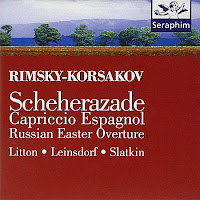
Rimsky-Korsakov - Scheherazade/Capriccio Espagnol/Russian Easter Overture (1995)


Budget compilation of popular Rimsky-Korsakov works by various conductors and orchestras, recorded in the '50s and '80s. All selections are favorites of mine.

Tracks 1-4: Scheherazade Symphonic Suite, Op. 35
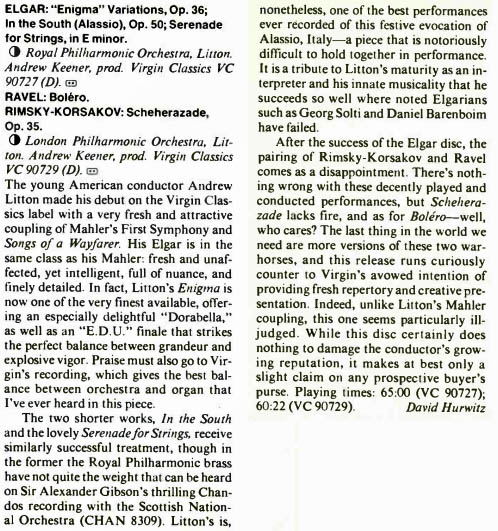
London Philharmonic Orchestra, conducted by Andrew Litton

High Fidelity, July 1989

The above review claims the performance "lacks fire" and I agree. Up until the lively final movement, it's all played safe; a bit timid and languid for my taste.

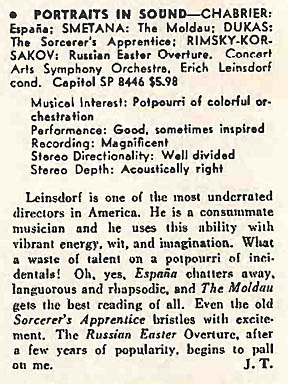
Track 5: Russian Easter Festival Overture, Op. 36
Concert Arts Symphony Orchestra, conducted by Erich Leinsdorf

HiFi Review, March 1959

This 14 minute piece takes a while to really get going, but the final third gets brassy, bold, and exciting. The sound is remarkably clear in the strings; the winds get a little muddled at times, but considering this track was recorded in the '50s, not bad overall.

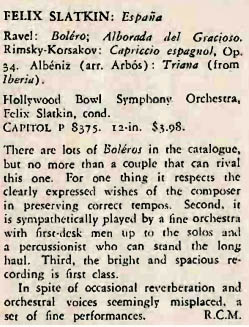
Track 6: Capriccio Espagnol, Op. 34
Hollywood Bowl Symphony Orchestra, conducted by Felix Slatkin

High Fidelity, March 1957

This orchestral suite is my favorite Rimsky-Korsakov piece - hands down - and this interpretation certainly does it justice. I could use a little more low end, but as with the previous track, not terrible sound for an older recording.

Personal Memory Associated with this CD: None

Previously revisited for the blog:
Scheherazade, Ernest Ansermet conducting L'Orchestra De La Suisse Romande (1994)
Scheherazade/Capriccio Espagnol, Charles Dutoit conducting the Orchestre symphonique de Montréal (1984)


Tuesday, April 10, 2012

Rimsky-Korsakov - Scheherazade Op. 35, Capriccio Espagnol, Op. 34 (1984)


Charles Dutoit conducting the Orchestre symphonique de Montréal.

One of my first CD purchases, this is a fantastic recording of both works. Gorgeous playing by the orchestra with subtle interpretation by Dutoit. My only complaint would be that the dynamic range is so big that the quieter parts are too quiet. When you turn the music up to hear the quiet part, you're then blown away like the guy in the Maxell ad when the loud parts come around.


Tracks:
1-4: Schereazade (Symphonic Suite), Op. 35. Here's what I said about this piece in an earlier blog posting for a different recording:
Scheherazade (1888) is perhaps Rimsky-Korsakov's most well-known symphonic suites. While it gets a little schmaltzy at times, this piece illustrates the Russians' fascination with the Orient/The Arabian Nights in the 19th century. Listening to this piece, you realize how much 20th century movie soundtrack composer John Williams owes to Rimsky-Korsakov, particularly in terms of orchestration.
My favorite movement is the 4th, titled Festival at Baghdad - The Sea - Shipwreck, but the entire piece is enjoyable because themes are passed around among the movements as Scheherazade weaves her tales. It is interesting that I mention Rimsky-Korsakov's influence on John Williams' orchestration, because I recently came across my volume of Rimsky-Korsakov's book, Principles Of Orchestration, that belonged to my junior high band director when he was a college student in Austin. Rimsky-Korsakov literally wrote the book on orchestration.


5-9: Capriccio Espagnol, Op. 34 (1887). Possibly my favorite orchestral work (at least that's what I'm thinking today...top 5 for sure). A Russian composer takes Spanish folk melodies and turns out a beautiful 16 minutes of music. I implore you to take the time to give this piece a listen sometime.

Personal Memory Associated with this CD: This CD, Movement V of Capriccio Espagnol in particular, got a lot of playing time while I was practicing my conducting technique in college. In 1989, I was so caught up in my own self-assessed conducting brilliance that I actually applied for a conducting fellowship at the prestigious Tanglewood Music Center. Fortunately, my application was denied because I don't think I could have faked my way through the score reduction exercises at the piano. I laugh now at how my classmates and I all thought we were serious conductors when all we were doing was preparing to teach junior high band students who could have cared less about what we looked like. All they want is a clarity, not showmanship.

Previously revisited for the blog:
Scheherazade (1994)

Sunday, April 17, 2011

Rimsky-Korsakov - Scheherazade (1994)


Ernest Ansermet conducting L'Orchestra De La Suisse Romande.

This is a budget-priced compilation of recordings from the late '50s and early '60s, but the digital transfers really aren't too bad, not much tape hiss at all. The interpretations are average and don't take any chances, so you get a fairly safe introduction to some of the composer's work. What I find interesting about these early recordings is that there is absolutely no attempt to go back, re-record, and splice in a cleaner performance. In other words, this isn't the most technically accurate performance you can find. Judging from the occasional errors in playing, this is a live recording with no overdubs. Although I already owned at least one other recording of Scheherazade, I purchased this set for the Russian Easter Festival Overture and discovered some of the Rimsky-Korsakov's lesser-known compositions. It's a lengthy double disc set, clocking in at 140 minutes.

Tracks:
Scheherazade (1888) is perhaps Rimsky-Korsakov's most well-known symphonic suites. While it gets a little schmaltzy at times, this piece illustrates the Russians' fascination with the Orient/The Arabian Nights in the 19th century. Listening to this piece, you realize how much 20th century movie soundtrack composer John Williams owes to Rimsky-Korsakov, particularly in terms of orchestration.

Overture to the opera May Night (1879) is long for an overture (8+ minutes), but is a lively piece that makes use of Ukrainian folk music.

A three movement orchestral suite taken from the opera The Tale Of Tsar Saltan (1900) contains 2 movements that are full of fanfares and typical Rimisky-Korsakov melodies, but the middle movement, depicting two characters adrift on the sea, contains no melodies, but just rolling, beautiful, lush harmonies. Also included is a relaxed version of The Flight Of The Bumblebee (also from The Tale Of Tsar Saltan, but not included in the suite). This is slower version is probably how the composer intended it to be performed, but the piece has taken a life of its own, becoming a virtuosic showcase of technical ability. I like this slower version. It's a nice change of pace.

The Russian Easter Festival Overture (1888) is a wonderful adaptation of two Russian hymns. Lots of good brass parts in this one.

Next is a multi-movement orchestral suite taken from the opera Christmas Eve (1895). Parts of this piece sound like they were lifted from Scheherazade, but the rest is very light and playful until the final section, "Procession to Midnight Mass and Carols," which is stately and uses the same hymn that Tchaikovsky uses in the 1812 Overture.

Rimsky-Korsakov adaptation of the Russian folk tune Dubinushka (1905) is simply they same melody repeated over and over by different sections. It's an exercise in orchestration, not thematic development.

Subtitled "A Musical Picture," Sadko (1867) is a tone poem that musically depicts the narrative of a Russian folk hero. I'm not a fan of tone poems in general and this one does little to change that opinion.

The final piece is a suite from the opera The Snow Maiden (1903). Meh.

Personal Memory Associated with this CD: Russian Easter Festival Overture was one of the first orchestral pieces I ever heard on CD, even though I didn't purchase my own copy of the work until many years later.