Since September 2010, this blog has recorded the journey of this music junkie as I attempt to listen to all the music in my CD collection. CDs revisited in their entirety from start to finish - no skipping tracks, no shuffle. Compact Discs only - no vinyl, no tapes, no files.

Showing posts with label Herbie Hancock. Show all posts

Saturday, June 20, 2026

Herbie Hancock - River: The Joni Letters (2007)

CD cover art

I just don't get it. Here we've got Herbie Hancock (I'm a fan) paying homage to his friend Joni Mitchell (I'm a fan) with an outstanding backing band and numerous special guests, including Norah Jones and an uncredited Prince. The thing won two Grammy awards: Album Of The Year and Best Contemporary Jazz Album. Everything indicates I should love this release, I simply don't, and I have no explanation why.

Hancock - piano
Wayne Shorter - saxophone
Dave Holland - bass
Vinnie Colaiuta - drums
Lionel Loueke - guitar

Album chart peaks:
  • US Billboard 200: #5
  • Billboard Jazz: #1

Tracks:

Personal Memory Associated with this CD: None

Previously revisited for the blog:
Best of The Blue Note Years (1988) Head Hunters (1973)
Round Midnight Soundtrack (1986) Speak Like A Child (1968)
Lite Me Up (1982) Maiden Voyage (1965)
Sunlight/Feets Don't Fail Me Now (1978/1979)Empyrean Isles (1964)

Takin' Off (1962)

Thursday, May 21, 2026

Herbie Hancock - Takin' Off (1962)

CD cover art

Note: the CD I listened to was the 2007 Rudy Van Gelder Edition with 3 bonus tracks.

Hancock's debut as a leader at the age of 22. The album wasn't always well-received at the time by the critics (see below), but is now considered with more respect and appreciation. In my book, it's a fantastic, swinging hard bop album that features some legends in the group playing some outstanding compositions. Plus it's freakin' Herbie Hancock, Jazzer Laureate of the United States. (I just made up that title, but it should actually exist and Hancock should be so named.) He's still touring at age 86!

Hancock - piano
Freddie Hubbard - trumpet
Dexter Gordon - tenor saxophone
Butch Warren - bass
Billy Higgins - drums

Original liner notes by Leonard Feather.

Reviews/ratings:
  • Billboard: "[Hancock's] work at the keyboard is impressive as are his talents as a writer."
  • Stereo Review: "He is a forceful, well-organized pianist, but here he shows little stylistic originality."
  • CashBox: "A nice showing."
  • Downbeat (★★★½): "slightly disappointing...Still, there is much to recommend in this release."
  • The Penguin Guide to Jazz (5th ed., 2000): ★★★½
  • The Rolling Stone Jazz & Blues Album Guide (1999): ★★★★½
  • The Virgin Encyclopedia of Jazz (1999): ★★★★

Peak on the US Billboard Top 200 chart: Did not chart

Tracks: It's a brave move to include all original compositions on a debut album; I'd have guessed the label might have insisted on a couple of standards. But if you can write stuff like Watermelon Man and Driftin' plus the beautiful ballad Alone And I, why would you need anything else?

Bonus tracks: Alternate takes of Watermelon Man, Three Bags Full, and Empty Pockets.

Personal Memory Associated with this CD: None

Previously revisited for the blog:
Best of The Blue Note Years (1988) Head Hunters (1973)
Round Midnight Soundtrack (1986) Speak Like A Child (1968)
Lite Me Up (1982) Maiden Voyage (1965)
Sunlight/Feets Don't Fail Me Now (1978/1979)Empyrean Isles (1964)

Monday, July 21, 2025

Herbie Hancock - Maiden Voyage (1965)


Note: the CD I listened to was the 1999 Rudy Van Gelder Edition.

A stone cold classic with a couple of songs that have since become standards. Hancock, who wrote all the compositions, was only 24 years old when the thing was recorded and it was his fifth album as a leader. Incredible. Over the past 60 years, it's earned many accolades (see below) and deservedly so. If you need an entry point into mid-'60s post-bop jazz, this is just the album you're looking for. Highly recommended.

Hancock - piano
Freddie Hubbard - trumpet
George Coleman - tenor saxophone
Ron Carter - bass
Tony Williams - drums

Much like the earlier Empyrean Isles album, Maiden Voyage was a concept album about the open seas. Also like Empyrean Isles, the album's liner notes were written in prose style by Nora Kelly. It is suspected that the name Nora Kelly was used as a pseudonym but I can't find anything definitive on the matter. In any case, you're better off with the 1999 reissue liner notes by Bob Blumenthal.

Reviews/ratings:
  • Downbeat (★★★★★): "This music communicates something good to me."
  • The Penguin Guide to Jazz (5th ed., 2000): ♛★★★★
  • The Rolling Stone Jazz & Blues Album Guide (1999): ★★★★½
  • The Virgin Encyclopedia of Jazz (1999): ★★★★
In 2017, Pitchfork ranked this album at #82 on their list of The 200 Best Albums of the 1960s while the uDiscover Music website ranked Maiden Voyage at #7 on its list of The 50 Greatest Blue Note Albums. And in 1987, this album was selected by Blue Note (Europe) as one of the 25 Best Albums on the label.


In 1999, the album was inducted into the Grammy Hall of Fame. Finally, the album is listed in the The New York Times Essential Jazz Library: A Critic's Guide to the 100 Most Important Recordings (2002): "Maiden Voyage is a chill-out record and a chilly one; it's got early sixties ennui all over it."

Peak on the US Billboard Top 200 chart: Did not chart

Tracks, ranked:
  1. Maiden Voyage
  2. Dolphin Dance
  3. Little One
  4. The Eye Of The Hurricane
  5. Survival Of The Fittest

Personal Memory Associated with this CD: None

Previously revisited for the blog:
Best of The Blue Note Years (1988) Head Hunters (1973)
Round Midnight Soundtrack (1986) Speak Like A Child (1968)
Lite Me Up (1982) Empyrean Isles (1964)
Sunlight/Feets Don't Fail Me Now (1978/1979)

Sunday, April 14, 2024

Herbie Hancock - Empyrean Isles (1964)


Note: the CD I listened to was the 1999 Rudy Van Gelder Edition with an 2 bonus tracks.

This was Hancock's fourth album release as a leader; a weak attempt at a concept album about the Empyrean Isles, described in the original, atypical liner notes written by Nora Kelly as "elusive and said to vanish at the approach of ordinary mortals" and "that incense-bearing trees blossom there," etc. You get the point. Needless to say, it fails in its task of being a concept album, but there are a couple of destinations here I don't mind visiting, especially Cantaloupe Island.

In 2017, Pitchfork ranked this album at #177 on their list of The 200 Best Albums of the 1960s with the following blurb:
Pianist Herbie Hancock was already an elite jazz session player when he led this set for Blue Note...But Hancock was also hard at work on his compositional craft. His four original pieces on Empyrean Isles prompt motifs based on brisk chord changes as well as scale-based improvisation. Nearly two decades before his embrace of turntablism on “Rockit,” Hancock was already signaling his intention to swing between radically different formal designs. –Seth Colter Walls
So they obviously like the album more than I, as does the uDiscover Music website, where this albums was ranked at #34 on its list of The 50 Greatest Blue Note Albums.

Hancock - piano
Freddie Hubbard - cornet
Ron Carter - bass
Tony Williams - drums

After recording this album, Hancock, Carter, and Williams (plus Wayne Shorter) would soon join Miles Davis to become what is commonly known as his "Second Great Quartet."

Reviews/ratings:
  • Stereo Review: "Lacks cohesion"
  • CashBox: "Jazzophiles should dig this session."
  • Downbeat (★★★★): "the tunes come off well"
  • The Penguin Guide to Jazz (5th ed., 2000): ★★★★
  • The Rolling Stone Jazz & Blues Album Guide (1999): ★★★★
  • The Virgin Encyclopedia of Jazz (1999): ★★★★


Peak on the US Billboard Top 200 chart: Did not chart

Tracks: As I mentioned earlier, Cantaloupe Island is the star here and yes, I was familiar with the tune before it was famously sampled by Us3 in 1992. My other top pick is Oliloqui Valley, which swings harder than it should and features a killer solos from Hubbard and then Carter. That doesn't mean the other two tracks (One Finger Snap and The Egg) aren't good, simply that I much prefer the first two I mentioned. Both One Finger Snap and Cantaloupe Island were chosen for the 1988 CD release, The Best of Herbie Hancock: The Blue Note Years.

Bonus tracks: Alternate takes of One Finger Snap and Oliloqui Valley. All tracks, including the bonus tracks, were recorded at the Van Gelder Studio on Wednesday, June 17, 1964.

Personal Memory Associated with this CD: None

Previously revisited for the blog:
The Best of Herbie Hancock: The Blue Note Years (1988)
Round Midnight - Original Motion Picture Soundtrack (1986)
Lite Me Up (1982)
Sunlight/Feets Don't Fail Me Now (1978/1979)
Head Hunters (1973)
Speak Like A Child (1968)


Wednesday, January 10, 2024

Herbie Hancock - Speak Like A Child (1968)


Note: the CD I listened to was the 2004 Rudy Van Gelder Edition with an 3 alternate takes added as bonus tracks.

The focus here is truly on Hancock's wonderful playing and composing. There's horns in the background texture, but they're just to add to the overall color of the pieces - they never solo, so it's Hancock that almost always has the spotlight on him (and that's a good thing). Add to that some swinging interplay between Hancock and legendary bassist Ron Carter and some deceptively subtle trap work from Mickey Roker and you've got an album that's definitely in the top quarter of Hancock's massive catalog.

Complete liner notes.

Hancock - piano
Thad Jones - flugelhorn
Peter Phillips - bass trombone
Jerry Dodgion - alto flute
Ron Carter - bass
Mickey Roker - drums

Reviews/ratings:
  • Billboard: "A warm swinging collection"
  • Downbeat (★★): "Hancock is a puzzle. He is a generally good and sometimes excellent accompanist, but his solo work here is dull."
  • The Penguin Guide to Jazz (5th ed., 2000) (★★★): "An easy record to overlook; well worth hearing."
  • The Rolling Stone Jazz & Blues Album Guide (1999): ★★★½
  • The Virgin Encyclopedia of Jazz (1999): ★★★


Album chart peaks:
  • US Billboard 200: Did not chart
  • Billboard Jazz: #14
  • Record World Jazz: #10

Tracks: Tunes so good they've been covered many times, including recordings by such artists as Miles Davis and Joe Henderson. My favorite cut is the beautiful title track, followed closely by the swinging First Trip. First Trip was composed by legendary bassist Ron Carter and is the only cut written by someone other than Hancock.

This RVG edition includes three bonus tracks: an alternate take of Goodbye To Childhood and two alternate takes of Riot. It can be fun to hear the different solos, but not of much interest beyond one or two plays.

Personal Memory Associated with this CD: None

Previously revisited for the blog:
The Best of Herbie Hancock: The Blue Note Years (1988)
Round Midnight - Original Motion Picture Soundtrack (1986)
Lite Me Up (1982)
Sunlight/Feets Don't Fail Me Now (1978/1979)
Head Hunters (1973)


Monday, December 12, 2022

Round Midnight - Original Motion Picture Soundtrack (1986)


Soundtrack to the 1986 film which starred saxophonist Dexter Gordon as an jazz musician and addict who finds acceptance in the jazz clubs of Paris in the 1950s. The album, put together by Herbie Hancock, consists of jazz standards and a few original tracks performed by an all-star group of musicians:

Soundtrack cuts not on this album are included on Dexter Gordon's 1986 companion album, The Other Side Of Round Midnight, which features the last recordings released under Gordon's name before his death in 1990.

For his work in the movie, Gordon was nominated for a Best Actor Oscar, losing to Paul Newman for The Color Of Money. However, this soundtrack won the Oscar for Best Original Score for Hancock. Many people consider that Oscar win to be controversial as there isn't much original music in the film and it beat out the wonderful scores of Ennio Morricone (The Mission) and Jerry Goldsmith (Hoosiers). Maybe those two split the vote and allowed Round Midnight to sneak in? It's happened many times.

I found this CD in the clearance bin and wondered how a star-studded Oscar winner could end up in such a place and then I spun the thing. Simply put, it's just ok. There are some great performances to be found - Hancock is fantastic throughout - but Gordon was dealing with health issues during filming/recording and sadly doesn't sound like the Gordon I know from his historic albums Go! and Our Man In Paris.

Reviews/ratings:
  • High Fidelity: "[Gordon's] tone is weak, his facility faulty, and his ideas serviceable yet never soaring"
  • Billboard: "Mostly standards, with performances of varying quality"
  • Stereo Review: "not the best Dexter Gordon album of recent years, nor is it hard to find more satisfying jazz albums"
  • The Virgin Encyclopedia of Jazz (1999): ★★★


Album chart peaks:
  • US Billboard 200: #196
  • Billboard Jazz: #7
  • CashBox Jazz: #3
  • Radio & Records Jazz Radio National Airplay: #2

Tracks:
  1. Round Midnight (Thelonious Monk, 1944) - could use a real trumpet player instead of Bobby McFerrin imitating a muted trumpet.
  2. Body And Soul (Johnny Green, 1930) - great solo from McLaughlin
  3. Bérangère's Nightmare (Herbie Hancock, 1986) - incidental music, not particularly interesting but certainly not a nightmare (see what I did there?)
  4. Fair Weather (Kenny Dorham, ca. 1964) - Not only was I surprised by Chet Baker's vocals, I was moved by them. One of the best cuts on the album.
  5. Una Noche Con Francis (Bud Powell, 1964)
  6. The Peacocks (Jimmy Rowles, 1975) - a tasty ballad featuring Wayne Shorter and an elegant solo from Hancock
  7. How Long Has This Been Going On? (Ira & George Gershwin, 1927) - In which Lonette McKee does her best Billie Holiday imitation and succeeds
  8. Rhythm-A-Ning (Monk, 1957) - Another choice cut. Wow does this thing swing - what a band!
  9. Still Time (Hancock, 1986) - a great last-call melancholy ballad from Hancock. I'd bet it fit the scene perfectly.
  10. Minuit Aux Champs-Elysées (Henri Renaud, 1969) - just Hancock on piano and the great Bobby Hutcherson on vibes. They play off each other perfectly.
  11. Chan's Song (Never Said) (Hancock, Stevie Wonder, 1986) - McFerrin's wordless vocals on a pop piece that would be noticeably anachronistic in a period film such as this. A bizarre way to end the album.

Personal Memory Associated with this CD: None. I don't recall ever seeing the film and it's not currently available on any legal streaming service (very few films released in the 20th century are available via streaming, but that complaint/frustration/discussion/argument is beyond the scope of this blog); however, I see that there's a new Criterion Collection Blu-ray release available.

Thursday, November 26, 2020

Herbie Hancock - Sunlight/Feets Don't Fail Me Now (1978/1979)


UK Import

2016 two disc set from Cherry Red Records.


SUNLIGHT (1978)
7 tracks, 49 minutes


I bought this two-fer set because I wanted the full 9 minute version of the lead track, I Thought It Was You. I was introduced to that tune, as one often is, via a 1983 British K-Tel album. Said compilation is quite good and it turns out that I Thought It Was You peaked at #15 on the British charts (it didn't crack the Hot 100 here in The States, but managed to climb to #85 on the Billboard R&B chart). In any case, it has been a common earworm for me ever since and the extended album version is worth the price of admission.

I could do without so much vocoder, but I can't help digging this stuff nonetheless. I think of it as pop-verging-on-disco music but with better solos.

Press of the time:

Album chart peaks:
  • US Billboard 200: #58
  • Billboard Jazz: #3
  • Billboard R&B: #31
  • CashBox: #70
  • Record World Jazz: #4
  • CashBox Jazz: #4

Tracks: There's only 5 tracks on the album, the shortest clocking in at 6:20, so there's plenty of room for Hancock to stretch out. The first four cuts go down real easy. My favorite solo on the album may be Hancock on electric piano in track 4, No Means Yes. The final track leaves disco and is straight up fusion complete with legends of the genre (Tony Williams and Jaco Pastorius), but after grooving for 30+ minutes, it's not the change of pace I'm looking for.

Bonus tracks: also included in this package are the shorter, single edits of I Thought It Was You and Come Running To Me.


FEETS DON'T FAIL ME NOW (1979)
12 tracks, 73 minutes


Before buying this pair of CDs, I thought I was totally unfamiliar with this 1979 album. Then track 3, Ready Or Not, hit my speakers and I started singing along ("Gonna get ya high!!") and realized that whatever radio I was listening to in '79 (most likely KILT-AM) played that funky tune often enough that I knew it. Then the liner notes here tell me the tune was written by none other than Ray Parker, Jr. who also plays on the track along with Sheila E. And suddenly this purchase just got a lot better. Ready Or Not was nominated for a Grammy in the category of Best Rhythm & Blues Instrumental Performance, curiously losing to Earth, Wind & Fire's Boogie Wonderland.

This was Hancock's 27th album and he went all-in on commercial disco/funk. Jazz purists almost certainly had fainting spells, but you can't blame a guy for using his talents to chase financial security. Again, the vocoder is a bit much, but I like pretty much everything else about it.

Press of the time:
  • Billboard: "patented riffs that have worked elsewhere."
  • CashBox: "top flight, full of funky bass and primal percussive rhythms."
  • Record World: "turned the corner on jazz and heads for a pure funk direction."
  • Stereo Review: "rather low-grade"
  • Smash Hits (5 out of 10): "Good to dance to but the long instrumental parts may get boring unless you're into clever musicianship"
  • DownBeat (★★½): "Just get up and dance mindlessly."


Album chart peaks:
  • US Billboard 200: #38
  • Billboard Jazz: #2
  • Billboard R&B: #16
  • CashBox: #52
  • CashBox Jazz: #3
  • Record World Jazz: #2
  • Rolling Stone: #53

Tracks: From what I can find, Columbia released three singles from the album's six tracks and they chose wisely:
  • You Bet Your Love (#18 in UK)
  • Tell Everybody (#47 US Dance)
  • Ready Or Not (#25 US R&B)

My favorite track, predictably, is Ready Or Not, but the best Hancock solo here is on You Bet Your Love. The best disco track is Tell Everybody while the jazziest track is Honey From The Jar, which reminds me quite a bit of Stuff. The final cut, Knee Deep, isn't terrible, but it pales in comparison with the other 5 tracks.

Bonus tracks: 6 of 'em - as many bonus tracks as there are album tracks. The three singles mentioned above are all represented here by their truncated 7" single versions as is Honey From The Jar, the b-side to Tell Everybody. Then we're treated to "Disco Versions" of both You Bet Your Love and Tell Everybody which include, as one would expect, longer intros, louder bass drum, more hi-hat, and handclaps.

Previously revisited for the blog:
The Best of Herbie Hancock: The Blue Note Years (1988)
Head Hunters (1973)

Tuesday, October 20, 2020

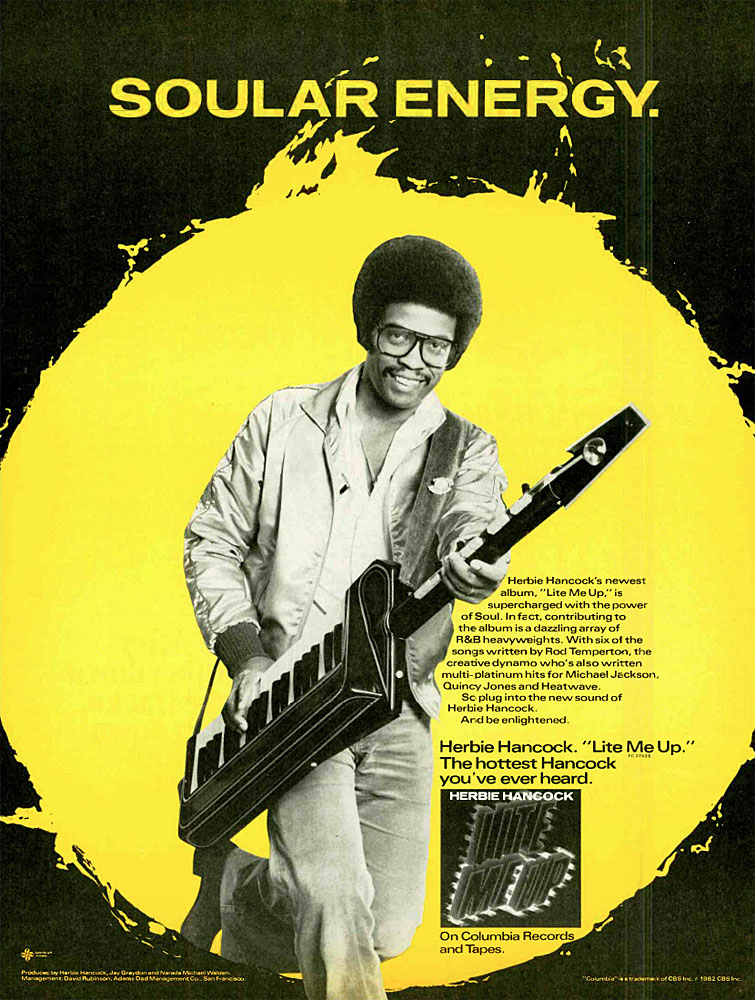
Herbie Hancock - Lite Me Up (1982)


Japanese Import

The magical year of 1982 continues to give me new musical gifts even after all these decades. You won't find any jazz on this album, but there sure is a lot of fantastic soul-pop. Lightweight, but a fun listen - even better in the summer. Hancock's last album before entering his electro-funk phase, the easiest way to think of this album is as the sequel to The Dude (or, possibly, Off The Wall). And I mean that in the most complimentary way imaginable - it plays like an extension of that Quincy Jones album. The most obvious commonality between the two LPs (other than Hancock himself) is songwriter Rod Temperton, who wrote or co-wrote 6 of the album's 8 tracks. There's also lots of familiar personnel from The Dude: Patti Austin, Steve Lukather, Jeff Porcaro, Michael Boddicker, Jerry Hey, etc.

More on the release from Hancock's personal website: https://www.herbiehancock.com/album/lite-me-up/

Hancock's vocoder use gets old rather quickly, but it does a good job of covering up his occasional vocal pitch problems. (Ironically, American Idol's Randy Jackson, the man who coined the nonsense word "pitchy," plays bass on track 5). Hancock wisely hands off vocal duties to Wayne Anthony on several tracks. Regardless, in every tune you can count on Hancock for a tasty solo, even if they're occasionally far too brief. For the record, his best solo work is on the closing track, Give It All Your Heart.


Press of the time:
  • Billboard: "Hancock's musicianship will satisfy his jazz fans if they're willing to wade through a hit or two."
  • CashBox: "a blend of techno-funk and jazz fusion that forms a potent platter"
  • Stereo Review: "thoroughly satisfying"


Album chart peaks:
  • US Billboard 200: #151
  • Billboard Jazz: #10
  • Billboard R&B: #31
  • CashBox: #113
  • CashBox Jazz: #6
  • Radio & Records Jazz Radio National Airplay: #4

Tracks: I enjoy the whole thing, but my choice picks are the funky title track and Paradise (a westcoast jam written by David Foster and Jay Graydon, produced by Graydon). Two singles from the album charted on the Billboard R&B chart in 1982: Lite Me Up! (#52) and Gettin' To The Good Part (#47). Paradise and The Fun Tracks were also released but did not chart.

Personal Memory Associated with this CD: a cut from Hancock's 1978 Sunlight album (I Thought It Was You) got stuck in my head, so naturally I had to listen to that album, then kept following his disco-era discography chronologically for a while and eventually found myself streaming this album. I was immediately hooked and picked up this CD fairly quickly, wondering why I'd never heard it before.

Previously revisited for the blog:
The Best of Herbie Hancock: The Blue Note Years (1988)
Head Hunters (1973)


Wednesday, October 24, 2012

Herbie Hancock - Head Hunters (1973)


Herbie Hancock has successfully reinvented himself throughout his 50 year career. In 1973, he produced this legendary jazz/funk fusion album that, at the time, was the best-selling jazz record in history (now I think Kind Of Blue holds that honor). If it sounds like a jazz pianist spent a lot of time listening to Stevie Wonder and Sly Stone wanted to play something along those lines, that's pretty close to what happened. Hancock had already begun to move toward synthesizers while playing with his previous sextet, but here he played all keyboards including, instead of having a guitar, my beloved Hohner Clavinet.

This is a highly revered work. It was included in the book 1001 Albums You Must Hear Before You Die, where it was called a "seminal jazz-funk masterpiece." The Library of Congress added it to the National Recording Registry in 2007 and it was enshrined in the Grammy Hall of Fame in 2009. Update: In its 2020 list of The 500 Greatest Albums of All Time, Rolling Stone ranked Head Hunters at #254.

Ratings/reviews:
  • Rolling Stone: "Hancock's best album in several years and should give Stevie Wonder and Sly fans something to think about"
  • Downbeat (★★★★★): "[Hancock] has both the skills and the creative vision to escape the trap of repetition"
  • The Rolling Stone Jazz & Blues Album Guide (1999): ★★★½
  • The Virgin Encyclopedia of Jazz (1999): ★★★★★
  • The Penguin Guide to Jazz (5th ed., 2000): ★★★★


Album chart peaks:
  • US Billboard Top 200: #13
  • Billboard Jazz: #1
  • Billboard R&B: #2

Tracks: Only four tracks and they're all good, but it's hard to beat the one-two punch of side one: Chameleon followed by a funky reworking of his 1962 piece, Watermelon Man. Those 2 tracks have sampled more than ten times by artists such as 2Pac, George Michael, LL Cool J, Madonna, and Snoop.

Personal Memory Associated with this CD:  I don't remember when I got this particular copy of this CD, but as a musician, I've played Chameleon and Watermelon Man more times than I can count.

Previously revisited for the blog:
The Best of Herbie Hancock: The Blue Note Years (1988)

Friday, December 10, 2010

Herbie Hancock - The Best of Herbie Hancock: The Blue Note Years (1988)


To be honest, I didn't know much about Herbie Hancock until his 1983 hit, Rockit. Then one day in college, I heard Maiden Voyage and couldn't believe it was the same guy. I eventually picked up some of his earlier recordings on Blue Note compilations, but it wasn't until I purchased this CD around the year 2000 that I had heard all these great pieces. Hancock is a wonderful pianist and composer, but he's also smart enough to surround himself with quality musicians like Freddie Hubbard, Thad Jones, Dexter Gordon, and Ron Carter. These pieces were recorded during the years 1962-1968. In addition to his own solo work, Hancock was playing with Miles Davis during those years. This is a fantastic sampler of Hancock's early work.

Peak on the US Billboard Top 200 chart: Did not chart

Tracks: In addition to standards like Watermelon Man, Maiden Voyage, and Dolphin Dance, I also like Driftin' and Cantaloupe Island. Here's the breakdown:
  1. Watermelon Man from Takin' Off (1962)
  2. Driftin' from Takin' Off
  3. Maiden Voyage from Maiden Voyage (1965)
  4. Dolphin Dance from Maiden Voyage
  5. One Finger Snap from Empyrean Isles (1964)
  6. Cantaloupe Island from Empyrean Isles
  7. Riot from Speak Like A Child (1968)
  8. Speak Like A Child from Speak Like A Child
  9. King Cobra from My Point Of View (1963)

Personal Memory Associated with this CD: This CD kept me company on trips to and from El Maton, TX.